Saturday, September 27, 2014

Blossom


"Patience with thy soul, for it is blossoming one breath at a time."

- Charles L. Mason, Jr. - 2014


Sunday, May 11, 2014

Friendliness!@#!@%


Back in the summer of 2013 the Conde Nast Traveler published their list of the un-friendliest cities in the United States.[1] Unfortunately, my current and a few of my former home cities were well represented.  The City of Sacramento was number 10 on the list, which did not surprise me, but saddened me all the same.
Well, since then I have been literally “running” an experiment on the friendly levels of my fellow Sacramentan's.  The morning after I read the Conde Naste article I went on one of my weekend runs along the American River Parkway, where I had always noticed how few people waved or said hello.  I made it a point that day and many others since to deliberately wave to at least 90% of the runners and walkers.

Here are a few observations.  I remind you that these are rough calculations:
  • If I don’t wave it is an 80 percent chance they will not waive or say hello.
  • People over 40 wave at higher rates than those under 40 and waiving and hello’s increase with age.
  • Waving at others and them waving back or saying hello or other encouraging works motivates me on my run.
  • Most walkers will wave.
  • Women under 35 wave the least.
  • More people wave or say hi or other comments when my 9-year old son is running with me.
  • 90 percent of people wave, if I wave first; regardless of race, age or gender.
  • My favorite is the 70-year (this is a guess) old woman who always says hello and motivates my son while telling stories of her father starting her to running at 7, the age my son started. I see her most Saturday’s and Sunday’s with her dog and cane.
  • My last outing was made easier by the much older gentleman walking vigorously past me each way yelled, “Good Work!”
I also did observations in other cities I visited since the start of this experiment.
  • Several trips to 2 of my former homes, Oakland (#2 on the list) and Los Angeles/Long Beach (#6 on the list) did not yield better results. Runs in Oakland around Lake Merritt yielded few waves on the weekends.  This may be due to the large number of people out; a few more waives came if my run was during the work week.
  • Los Angeles/Long Beach was not good for waves at all. Even if I waved to them, I would not get more than 50% of people waving.
  • In February, I was in Denver and ran long their downtown creek. People were awesome and almost everybody waved or said hello before I could get my hand up. I was mostly struggling with adjusting to the altitude.
In the end friendliness starts with the self. Yes, different demographics and locations may have their friendly-challenges; however, if we show kindness to others it tends to come back many times over.

Thursday, November 28, 2013

Holidays and Family History

On this day of giving thanks, when many of us are surrounded by family and friends, it is a perfect opportunity to learn more about your families. Over the next 5 weeks, we will see many family members and what better time than to check into your genealogy and start building your family tree.

In the last few months, I ramped up my efforts to build my family tree.  It started with revisiting the tree I had started a few years ago on www.Ancestry.com, which was poorly populated and mainly restricted by me not asking family members questions and having them start asking questions and reviewing the many hints that Ancestry.com leaves you as you populate your tree. 
I started of course with quizzing my parents and started organizing my notes online.  Each day I worked on my tree, I would find new family members, solve family “secrets” and as of now track my family back to the late 1700’s in a few cases, something that is not easy with African-American families.  My journey has taken a course through California and Detroit, Michigan, and through a lot of Alabama and into Georgia.  In recent days we have found ourselves virtually traveling to Mississippi and North Carolina.  There is also a line in the family that is taking us back through New Orleans to France and one that is inevitably headed to Ireland.  Most importantly I have had a ball talking to my Mom and Dad and other family members as I fill in the gaps in our family tree. 

I also finally pulled the trigger and ordered a DNA test.  As an African-American, it was practically impossible until DNA testing became affordable to trace the exact regions and countries of the world that you were descendent from because of the lost history tied to the “peculiar” institution of slavery.  I often balked at the cost or just talked myself out of it, but in September I ordered the test and in late October I received the results.  For the first time in my life I can tell someone specifically what regions of the world my family was from.  The funniest experience came when my 9 year old son, Miles looked at the results and saw that we had European ancestry and with a look of exasperation asked, “I’m white?!”  I told him yes partly.
The common myth that we were part Native America was busted, as my results showed no traces to Native/Indigenous Americans.  No direct link to East Africa, as had been rumored.  However, the results did show that my ancestry was primarily Western African (74 percent), not a surprise.   The results:

·        Mali – 14%

·        Cameroon/Congo – 13%

·        Nigeria – 13%

·        Ivory Coast/Ghana – 13%

·        African Southeastern Bantu – 12%

·        Benin-Togo – 7%

The majority of the rest of my ancestry was link to Europe (24%).

·        Ireland – 9%

·        Iberian Peninsula – 3%

·        Europe West – 3%

·        Europe East – 2%

·        Scandinavia – 2%

·        Finland/Northwest Russia – 1%
There is also 2% Central Asia that ties into the area of the -stans. 

The experience and journey continues.  I talk about my results and the building of the tree all the time. It is the subject of bar talk and pops up in staff meetings.  I have even found several 2nd to 6th cousins that I am making links with to fill out our family tree and share information that will help unravel some of our family mysteries.  It feels great to know where you come from and who you come from.  I spent all my life stuck in this mystery, thinking I was going to have to take an Alex Haley type journey in my retirement to solve it, while older family members passed always and memories were lost. 
This weekend I will talk to my 93 year old grandmother and tell her about what I found out about her mother’s family that she either never new, chose to forget or was never asked.  She will fill more gaps and tell many stories and yes we will get her DNA test these holidays to further tell our story.

I encourage all people, no matter what you know about your family history to do a DNA test; they are much cheaper and comprehensive these days.  It is a path not only to your history, but it opens up many opportunities to richly connect to family members known and unknown and maybe you might turn off the T.V. and put down the smart  phones for few hours and start filling in some trees and recording stories before your living historians leave this existence.

Friday, October 18, 2013

Yoga, Super Dude and Me


Many people know that I practice yoga at least a few times a week.  Well, likely more, since I am practicing often when I am not on my mat.  From the time he was born, I have introduced some aspect of yoga to my son, Miles.  At first it was a fun kid’s yoga game that we would play and he learned some of the more kid-friendly poses like the Cat-Cow sequence.   Later when he was pushing past the terrible 2’s and making his way to the ripe old ages of 4 and 5, I started teaching him breathing techniques to deal with anger and impulses.  Last year when he was 7 creeping towards 8 I enrolled him into a week-long yoga camp put on by Yoga Across America (http://www.yogaacrossamerica.org/drupal-7.0/) and he had a blast.  He tried my yoga class once around this time, but it was tough for him and he dropped out about half way through.  I was proud of him for making it that far, if he only knew how hard it was for me when I entered that studio for the first time.  Later in the year the studio I practice at added kids classes a few days a week, while parents poured and I do mean poured into the main studio to practice.  He loved it and he went several times.

Then…
This summer arrived and he turned to me one day and asked if he could come to my class again.  He wanted to spend more time with his dad and I was pretty committed to my trips to the studio.  Let me explain a bit to about where I practice yoga.  It is at Zuda Yoga (http://www.zudayoga.com/) in Sacramento.  Zuda teaches Power Vinyasa yoga.  This means that a bunch of Type A personalities pack into a room that is heated to 90 or so degrees and flow through a practice that includes many moves that build strength.  On my first visit to tour the studio a few years ago the lady at the desk said, “....this practice will get you cut, MMA guys practice here.”  Mind you I had spent the previous 6 months in a more gentle and restorative practice and was headed to a Ashram for a week upon hearing this news, but 10 days later there I was in the back of the room sweating out all the toxins in my body and observing which of my muscles I had never used or wanted to use.  I never drank so much water or created greater pools of water from my own flesh.

I turned to my then 8 year old son (he turned 9 in July) that day and said, “Okay.”  This would begin the summer’s journey of about 8 classes of yoga I would attend with my son. I was excited and a bit skeptical and pretty sure I was leading him to a pretty big life lesson.  This was true, but the biggest life lesson would be for me, not him.  As all parents know, it is hard for us to watch our kids do something and not want to assist or fix or make sure they do it right and follow instructions.  This is particularly true with Miles and I, his independent spirit has you keeping an eye on him at all times and this does not mix well with yoga.  Yoga is you on your mat, pushing through your crap or knowing when to back off or rest. 
Well…

At first this was not an option for Miles.  As we sat in the back corner that I occupy every time that I practice at Zuda.  Yes, I arrive 30 minutes before class to ensure that I sit in that same spot each time and have time to meditate.  My son would plop right next to me and we would begin the routine of filling our water bottles, and laying out our mats and grabbing our blocks.  I would meditate and he would go to the reception/shop area and talk with the friendly staff and other yogi’s as they came in and hide under the clothing racks.  Sometimes he would pop in to give me a kiss and then disappear back out front.  As practice would near, I would get nervous and start going out to get him back into the studio and on his mat.  I was mostly worried that he was disturbing someone or would try to skip out on class, but each time he would walk back in with me, partially complaining about the heat.
On the first day he was great, Miles made it all the way through, tried most of the poses and only left midway for a few minutes to go to the bathroom.  The bathroom break would become part of his routine and I would be filled with anxiety each time, until he returned to his mat and he returned each and every time.  The next 2-3 times would be more difficult, there was more complaining from him, more correction of his poses from me, more breaks on his mat from him, less pre-practice meditation from me.  I was struggling in my practice and was clearly focused on his mat, not mine.  What is a dad to do?  Here he was typically the only kid in the class and loved by the teachers, staff and other yogi’s.  They all ask about him every time I go to practice.  However, for me it was not enough and this is where the learning begins.

Through the last 6 classes he would attend with me, I begin to notice I was journaling in the morning before each class more and more about my relationship with my son and how I could be more patient with him, not yell so much, allow him more space to roam in the world.  So, I made a commitment to remain on my mat physically, mentally and spiritually and to let his practice be his own.  There was nothing easy in this proposition and I can say I never fully lived up to it, but I struggled through it each time.  I found that the more I focused on my practice and me, my heart opened up more, the kinder I was to him and the more space I gave him to explore his practice.  We always got along better after yoga class. Despite the struggles for him to complete each class, he always said he felt refreshed after class.  It also meant that we were headed home to change and find food and lots of it, since we were always really hungry afterwards.
These days I miss his presence in class and cannot wait for him to join me in December for a few classes during his break from school.  I am thankful that yoga has deepened and improved my relationship with my “Super Dude” son.  However, in the end the one that really grew was me.  I have grown as father, a yogi and a being, whose self and relationships have expanded with more kindness, patience, tolerance, compassion and love and all because my son wanted to do more things with me.

Sunday, July 14, 2013

Marching Down Auburn Boulevard


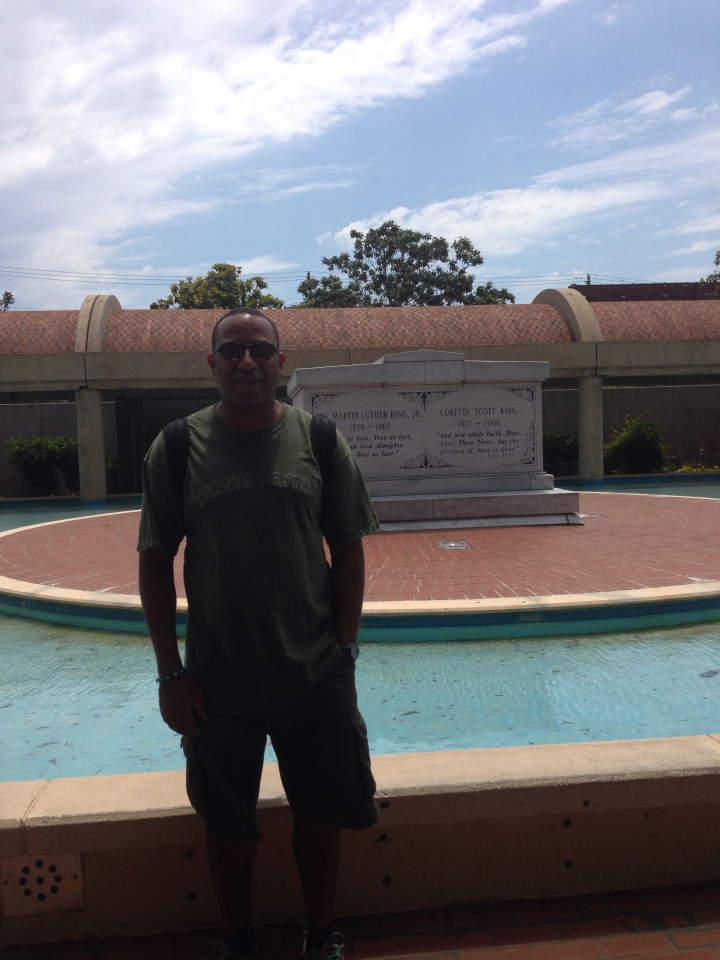
This morning I drank from the mug I purchased at the King Center in Atlanta back in April during a trip to the National Brownfields Conference.  I remember as I left my hotel at the CNN Center and walked through Olympic Centennial Park and eventually onto Auburn Avenue, headed to the King Center, unaware what emotions would rise up in me during my final day stroll.

I was not surprised when not long after I left downtown and edged towards the freeway underpass that there would be signs of blight in the neighborhood, but was pleasantly met by the construction of the new trolley that would eventually link the Martin Luther King Historic Site to Centennial Park.  You could see the signs of change emerging along the way.  I accidentally found the site of Madam C.J. Walker’s shop, which stood across the street from a large community garden.  Around the corner was a bake shop called Sweet Auburn, where an African-American woman has toiled in her small shop generating bake goods, jams and syrups, since 1997, anticipating the revival of the once vibrant center of African-American life.  There was the headquarters of the Southern Christian Leadership Conference and a mural of John Lewis on the side of a decaying building that screamed with hope.


As I stepped onto the grounds of the King Historic Site, I was greeted by the old and new Ebenezer Baptist Church’s and the immediate confusion of which way to turn.  I also remembered Nathan McCall’s book, “Them,” and realized I was in the gentrifying neighborhood depicted in the book, similar to my own adopted neighborhood in the Oak Park section of Sacramento.  It was at this moment that tears staged under my eyelids and would remain their through every step.  My body felt like spirits from the past were talking to me and I walked deliberately slow, as I observed each part structure.  The beautiful collection of roses in front of the National Historic Preservation building; the footsteps in the Civil Rights Walk of Fame, where I compared my feet to the likes of Desmond Tutu and Sidney Poitier.  I rejoiced at the statue depicting the movie’s Root’s “Behold” scene, smiling fondly of my recent viewing of the series with my 8 year old son.


My backpack continued to grow as I added souvenirs for my family and myself at each stop.  Finally, I stumbled upon the Reflecting Pool, where the bodies of Dr. King and his wife, Coretta Scott King are enshrined.  A young lady asked me if I would like her to take a picture of me in front of the pool, she was a recent transplant from my hometown of Los Angeles and was working at the King Center for Nonviolent Social Action.  It was there standing in front of their crypts and staring at the eternal flame that tears leaked under my glasses.  I found the connection to my current work and journey in life.  I could see through the portal of the Civil Rights Movement of our past to the our current struggles to address ongoing environmental, social, legal, food and other injustices that still permeate our society.


Most that walked around me seemed to be having similar revelations, we all smiled at each other softly, even in the museum exhibits that depicted the violence of the struggle, with soft tears in our eyes.  My journey back to the hotel and conference, in the increasingly hot sun, were simple steps in my modern athletic shoes, and paled in comparison to the hard, stubborn, leather business shoes that King, Lewis and many used to traverse roads, bridges, cities and towns.

Thursday, June 13, 2013

The Arena and Basketball and the Community

In the past few months the City of Sacramento was able to secure the arena deal and the NBA’s approval to keep the Sacramento King’s in Sacramento. They waged a battle with the City of Seattle that was robbed of their team several years ago after an ownership change and at times with the electorate and other opposition in the City.  Mayor Kevin Johnson worked diligently on this venture and set in place an economic engine that will revitalize Downtown Sacramento and generate thousands of jobs.  As a 10-year resident of Sacramento, I fully realize the benefits of the arena and related development to the economic health of the City and region.  I have been fortunate to witness the boom of restaurants and bars in the Midtown/Downtown area in the last 10 years, which was sorely needed.  Also, as an advocate of infill-refill development, I hope to see the former vitality of the Downtown area return that was decimated by Urban Renewal, which displaced many residents, with no return on investment, with a disproportionate impact on low-income communities and communities of color.

As the development moves forward there are three key areas that I hope the City, new billionaire owners, Mayor Johnson and other influential parities prioritize:
  • Community Benefits Agreements – The arena and related developments include community benefits agreements that includes a real and meaningful process where community needs are addressed, especially for surrounding neighborhoods and businesses, populations in the City and County that are at greatest risk and address environmental risk that may arise during the development process.  The developers and City should and must sit down with all interested parties to address these issues.  Included in these agreements:
    • Local jobs to local people – Jobs during construction should prioritize local Sacramento residents and where skill gaps exists, job training should be put in place to increase opportunities for employment for low income individuals and individuals of color.  This should remain the same for jobs in the arena and surrounding economic development projects.
    • Contractors/Business Opportunities – Prioritization should be given to local and minority contractors/business owners/entrepreneurs or fair partnerships that involve a diversity of groups to include all of the above.
    • Affordable housing – Any development that includes housing should provide for 15-25% affordable housing, with some of that housing dedicated to workers who will work in the new or renewed developments.
  • Green and Greenwise Sacramento – The Mayor through his Greenwise Sacramento initiative a few years back, touted making Sacramento the “Emerald Valley” of the United States.  There is not a greater opportunity than the arena and related development to prioritize creating an energy neutral arena and related projects.  In this time of climate disasters, rising utility cost and economic challenges, we must strive to build major projects that speak to our future and not just the current bottom line.  The Mayor has brought together an impressive group of billionaires and millionaires to Save the Kings, now it is time for Sacramento to truly emerge as the “Emerald Valley” of Sacramento and lead the way.  Many standards exist such as LEED Platinum, Built It Green, Living Building Challenge and others that point us to sustainable building, but also to sustainable environments, incorporating urban agriculture, reuse of materials, rain water capturing, green roofs and walls, recycled/reclaimed material and many other innovations in green and sustainable development.
  • Future Efforts – The efforts to bring billionaire attention and investment into Sacramento from across the state, including the support of Senator Darrell Steinberg and others was an amazing rallying of the local, regional and statewide troops.  As we move forward and dream of Sacramento being an economical, socially equitable and environmental safe model for the country, if not the world, we cannot achieve these goals without ensuring that the most vulnerable in the region are benefitting from such dynamic investments. I lived in Washington, D.C. during the installation of the downtown arena that turned previously underserved areas, littered with drugs, prostitution and abandoned businesses and homes into million dollar homes and condos, while displacing the residents that suffered and struggled in those communities for years.  Sacramento has the chance now to focus that billionaire investment in our City to not only help our downtown core explode, but to also help to impact the Mayor’s native Oak Park and Del Paso Heights and West Sacramento and Meadowview and North Highlands and South Sacramento and all of the communities that could be transformed by the multi-million dollar investment that is going into the Arena Project, with a focus on lifting up current residents that love their communities and hope to stay in them for years to come.
An Arena, Downtown Development and community development for ALL Sacramentans can be achieved through a cooperative process that includes and involves all members and sectors of our community. I look forward to observing and participating in this local historic process.

Monday, June 10, 2013

Health Care, A Twinkie, Some Coke and a Dose of Pesticide

I have been thinking about last year’s decision by the U.S. Supreme Court and contrasting the debates against any form of universal health care with the discussions in the country about eating and other lifestyle choices that cost the country billions of dollars each year.[1]  Regardless of how you feel about health care reform, we should be concerned about the impact of fast food, junk food, pesticides and chemicals, genetically-modified food and other factors have on our health and well-being, which all impact our economy.

Should we not require individuals in society to have health care, with strong preventive requirements, if we are going to refuse to responsibly regulate what they consume?  Especially, since it will potentially impact their long-term health and cost dollars in premiums, emergency room visits and long-term care.  In addition, potential cost to our mental health, criminal justice and disability systems.

If we are going to support the proliferation of unhealthy choices in our society, bolstered by food infused with pesticides and genetic alteration that cause unhealthy and unwanted outcomes.  See, the early onset of puberty in young women throughout our society and especially in populations reliant on these unnatural choices.[2]

Many want to blame the rising cost of health care on recent immigrant populations in our county, but studies have shown that 1st generation immigrants have equal or better health outcomes than their American counterparts.  We don’t see the negative consequences until subsequent generations.[3]

Obama Care may not be perfect, but neither are the food and beverage choices we consume and support in this country, in the name of economic profit for a few.  We defend the right to drink a Coke or eat a Twinkie as vigorously as we oppose having to pay for health care, unknowingly or oblivious to the impact our choices have on the cost of health care for our fellow American’s.  


Monday, December 19, 2011

Ubuntu, Buddha and Me

This blog is a bit of a preview of beautiful things to come. The New Year is upon us and over the last few months I have been contemplating my next big writing assignment after I finish my collection of short stories in early 2012. On a recent trip, I was sitting in a meeting and a title and subject came to me. The setting of the book would be me, me the last few years as I have faced some of the most difficult times of my life, while also being given the most beautiful gifts of my journey thus far.

The title of my pending book will be Buddha, Ubuntu and Me, this may require me to self-publish, but that is not inconsistent with who I am. There are two streams of inspiration for the book. First, I did borrow the title of the book a bit from a family member. For many years my second cousin, Lynne Duke wrote for the Washington Post. Thought I don’t remember meeting her as a young child, since she was one of the few of my mom, Anice’s immediate family members that was not at the many of the large family gatherings. I lived in D.C. off and on for years and I had unknowingly been reading Lynne’s articles in the Post for a few years and one day mom asked if I had read any of her articles and I thought about it and finally made the connection. I was notorious for reading articles and focusing on the title and subject and not the author, especially since on most days I read most of the paper, wherever I was.

I began to send articles home occasionally or collect them to bring home with me during holiday trips or my many moves back and forth between CA and DC. Eventually, Lynne was assigned to follow Nelson Mandela and his presidency and was assigned to South Africa as the Post’s correspondent. I relished in reading her articles and still regret not taking the open family invite to come to South Africa and see it all. However, I would be introduced to the term Ubuntu and South African life through her words. At the end of her tenure in South Africa, she wrote a book, Mandela, Mobutu and Me. From here is where I have borrowed the rhythm of my title.

The other inspirations from my title are implicit in the words. First, Buddha, which alludes to my inspiration from Buddhist and Yogic traditions. Though not necessarily Buddhist, I do follow some practices from Buddhism, I meditate most days and practice yoga at least twice a week for the last several years. I have also been fascinated by both traditions and their interconnections since childhood. Many of these practices have been an important part of my re-discovery of myself.

The second word is Ubuntu, which is a South African term that has several transitions, but speaks to the common humanity of all people. Three years ago, while forming my non-profit organization, I struggled to name it for weeks and new that part of the name would have the word green it to symbolize our desire to green all communities, not just the affluent. I had for the past 10 years, periodically put the term Ubuntu on my email signature, using one of the many interwoven definitions. Of all the great quotes and statements I posted over the years, none ever received more positive feedback and inquiry than Ubuntu. After a final night of thinking in early 2009, Ubuntu Green was born and it is now my professional passion.

The third word in the title is Me. This was the hard one, because writing about me and not hiding it in a story or poem has been one of the hardest things for me to face. I feared what I would find and I feared the reaction of others that may feel threatened or hurt by the truth of my words. However, as I re-found me and the beauty of me and it became clear that part of my journey was to eventually write my story, without fear or pain or judgment.

My inspiration is now upon me and this blog is the first step in the drafting of Buddha, Ubuntu and Me. I am not sure it what it will inspire in the world, but this journey has inspired me to live a beautiful life where I give to myself, my family, my friends, my community, my world every day.

Happy Holidays!

Sunday, October 30, 2011

Occupy

That last few days I have been observing the Occupy activities in Oakland, California http://www.occupyoakland.org/. I live in Sacramento, but thought it would be interesting to observe the City I lived in briefly before my move to Sacramento 9 years ago. It just so happens that the demonstration is across the street from where I worked back then and a few blocks from where I lived. The last large gathering I attended in Frank Ogawa Plaza (now renamed Oscar Grant Plaza by the community in honor of the Bay Area Rapid Transit police slain Grant on New Year’s Day 2009) was an Obama rally on St. Patrick’s Day 2007. The mood was much different that day Obama was the upstart, young Senator from Illinois, who was at best third in the polls at the time. John Edwards and Hillary Clinton were still the frontrunners, and very few were predicting an Obama victory. A few weeks before I had made my decision to support Obama and was glad that the work event that I was attending inside Oakland City Hall coincided with the rally. I stayed for a while, collected a few t-shirts and other memorabilia for myself and family, including my now well-worn green St. Patty’s Day Obama t-shirt that now gets some of the similar bad looks I receive 4 years ago from different people, a far cry from the cheers it received in late 2008 and 2009 when wearing the shirt and other Obama gear when running in Sacramento and whatever City I traveled to for work or pleasure. Obama was more like a folk hero and to some a revolutionary. The pending election results would break molds on how to conduct elections in the future and put a stark imprint on race relations in this country. The energy and optimism of that day can also be felt this weekend by the Occupy Oakland participants.

Despite the recent violent clashes with the police, the camp is amazingly peaceful and orderly. Yes, there is the free flowing scent of marijuana in corners of the camp or in nearby streets, a possible indirect protest aimed at marijuana legalization and the recent federal crackdown on medicinal marijuana laws established by the citizens of the State of California. However, you can see many efforts to address the public health concerns around the camping. Portable potties are set up on site, washing areas for hand and face sanitation are available, food is being purchased and donated to provide nutrition and special tents and areas have been set up to support young children. What are particularly interesting are the ongoing meetings that occur in circles around the Plaza. This morning I came across a Shambhala group that sat in silence on the steps of the amphitheater. Yesterday organized meditation and yoga classes could be witnessed. Many strategy sessions were occurring and discussions could be heard on many subjects. At one morning session, participants read from books and articles that inspired them to act. Though most of the occupy crew is younger, there are many older folks that are actively involved or observing or assisting in the success of the movement. Not surprising in this liberal enclave, by I am sure this is happening nationwide.

The Occupy Oakland community makes decisions by a vote of at least 90 percent of members. They recently agreed to organize a General Strike and Mass Day of Action. On November 2nd, they are asking that corporations and banks shut down or get marched on and welcome students to walk out of school. It will culminate with a march to the Port of Oakland, intent on shutting it down at 5:00 p.m. I eagerly anticipate the result of this.

In many ways, the Occupy movement stands in the face of the promise of Obama as President of the United States. The progressive, liberal promise, with a twinge of social revolution has been drowned by the fiscal crisis in this country, the rise of the Tea Party and the more moderate response from the Obama Administration. Many of the young people and minorities who voted for the first time in 2008, embracing the HOPE of Obama, now crowd parks and squares nationwide, pushing forward an agenda that calls for the end of corporate greed and control of our country. Obama obviously faces a hostile House of Representatives bent on his removal from office, in all his efforts to transform this country, and this cannot be overlooked as he takes criticism from the very folks that catapulted him into office.

I often look at the solution in all things, as we know the corporation and financial structure behind them are going nowhere fast, but we can implement laws and regulation that balance the playing field significantly more in this country. However, I am always inspired by the efforts of everyday Americans who have come up with innovative ways to transform society. I recently came across a Northern California non-profit founded by a young woman, Rebecca Burgess to source all of our clothing from fibers and dyes were produced within 150 miles from where she lived. This move directly provides economic, environmental and social impact in her community. The organization, Fibershed, http://www.fibershed.com/ has spawned a community of individuals dedicated to changing how they live and interact with each other. All protest to gain political and economic power, must be balanced by new solutions once victory is won.

As the Occupy Movement spreads throughout the world and builds sustainability, I hope that Wall Street, the Obama Administration, local government and others will find ways to work with these growing voices to transform our country in support of all Americans and not just the 1%. As we have bowed to the relatively small, but powerful Tea Party, we should open eyes and ears and listen to this more populist movement, propelled by our future.

Sunday, April 19, 2009

Oak Park Starbucks Please Don't Go!

Sacramento in the mid-2000’s began a bit of a renaissance with the arrival of former Bay Area residents pushed East by rising housing prices. As housing prices soared in Midtown, Downtown and in East Sacramento, folks turned towards the outer suburbs and communities like Oak Park. Still existing in the community of Oak Park were long-term residents with over one hundred years of history that have suffered the crime and economic decline.

An ambitious project sponsored by the St. Hope Development Company, included the 40 Acres Art and Cultural Center, located in a century-old building in the heart of the old business district. Another tenant in this development is the corporate giant, STARBUCKS.

Yes, Starbucks-- that ubiquitous coffee icon that in the last 20 years has spread faster than the plague and even McDonald’s. As a rule, I tend to avoid Starbucks and seek out independent cafés and tea shops to patronize. The Starbucks in Oak Park, however, is an exception. It borrowed from the Magic Johnson business model by partnering and branding it with St. Hope founder and former N.B.A. star, Kevin Johnson. At the time of its opening, I lived in another part of Sacramento, but I began to frequent the Oak Park Starbucks and other 40 Acres businesses in an effort to support the community and further educate myself on its history.

Last week, Starbucks announced another round of store closings, which includes the Oak Park location. It has emerged as a central gathering spot for the community. Long-time residents, Sac High students and staff, new home owners, McGeorge Law School students, community leaders and others, gather at the Starbucks daily for an untold number of reasons.

It serves as one of, if not, the only location in the neighborhood, where all members of the community can gather in a safe and communal environment. I live a few blocks away and wonder what will take its place to bring hope back into the community. Yes, the coffee shop brings hope, as a drug free, crime free zone that demonstrates the positive aspects of future development in the community.

It is time for the community to rally and petition Starbucks to reconsider closing the store. Kevin Johnson is now our mayor, and I hope his sights are still trained on 5th and Broadway, by seeking solutions to save or replace this center piece to our “town square.”

Link below to petition to save the North Oak Park Starbucks

http://www.inmycommunity.com/imc_joomla/index.php?option=com_chronocontact&chronoformname=Starbucks

Sunday, April 12, 2009

Savoir?

Power
falling
400 + years
Past Plymouth Rock
on
Hardened souls
on
Delivered spirits
on
Drowned middle passage screams

Native Son
traveling seas on the heels of independence
to
conquer the masters
daughter

to
deliver
hope
as offspring

Past
room less chains
strange fruit
and
raped maternity

Past
burning Watts
crack lined Ghetto's
and
disinvestment

to
deliverance
of our

SAVIOR?


Sunday, November 16, 2008

Ami I A Black Gentrifier?

I recently, I became a 1st time home-buyer. Yes, it sounds perfectly strange and perfectly right in this wonderful economy. I bought in the first suburb of Sacramento, Oak Park, the home of former NBA player Kevin Johnson, the Major-Elect of Sacramento, and the home of a history of crime, drugs, violence and failed schools. It is also home to a rich African-American history, and now diverse community attempting to blend the past, present and future.

I have joked on many occasions over the past few months to friends and family that I am a “Black gentrifier,” but is that even possible? I targeted the neighborhood two years ago for its relatively inexpensive homes (made even cheaper by the mortgage crisis); improving educational system (made better by Johnson’s St. Hope organization’s charter schools and new pre-school, which my 4 year old son attends); improved crime statistics in the sub-neighborhood I targeted; the opportunity to be a role model to others in the community; and the appearance of professionals and families, who many just happen to be white. My financial calculations also gave me the hope that with some upgrades and patience, I would build significant equity in the home over the next several years, despite the current economic and housing crisis. I was also drawn to the diverse ethnic and racial makeup of the community (one third Latino/Hispanic, 20% African-American, and 20% Caucasian),[1] and the existence of a faith community committed to the neighborhood led by the Family Life Center (St. Paul Church) and St. Hope.

I am recently finished reading a novel by Nathan McCall, called Them. It centers on the gentrification of the Atlanta neighborhood where Dr. Martin Luther King’s church and home are located, the Old Fourth Ward. I found myself fascinated by being torn in identifying with both the white couple that gentrifies the neighborhood and the African-American characters that watch their community change overnight. For example, in Them, a long standing Black owned corner store is sold and replaced by a café/coffee shop. The long-time African-American residents eulogize the loss of a neighborhood institution, while predominately new white residents rejoice at the opening of the café.

In my most altruistic thoughts and discussions, I see my presence in the community as a positive. Though not from the Oak Park or Sacramento, I have lived in predominately Black Communities (many that eventually or were being gentrified) throughout my adult life and during my early childhood. My son is a student in the community and we live a block from the predominately Black Sacramento High School, which was rescued in recent years by St. Hope and turned into a multi-themed set of charter schools. I cannot hope but suspect that our presence and activity in the community, through community involvement, donations to local charities, participation in local school and community events, and local activism, serve as a positive role model for the young students walking to and from the high school.

It still makes me wonder, can a Black professional assist in the gentrification of the neighborhood? By definition the concept of gentrification implies that someone of greater means is replacing someone of lesser means in the community. Through a quick Google search I was able to pull up the following definitions of gentrification:

“Gentrification, or urban gentrification, is a phenomenon in which low-cost, physically deteriorated neighborhoods undergo physical renovation and an increase in property values, along with an influx of wealthier residents who may displace the prior residents.”
“The process in which a neighborhood is transformed from low-value to high-value properties.”
“colonisation of an urban area by a higher socio-economic group.”
“The phenomenon of a formally industrial or dilapidated area becoming attractive to middle classes through improved services, access or a perception of "trendyness".

What is missing from these definitions is the race and ethnicity of the individuals, families, and businesses in the aforementioned displacement process. It is clear that there is an income displacement, but far too many times the individuals that are being displaced in a community are Black and Brown. Often the displaced individuals are forces to move to first, second and further ring suburbs that at one time demanded and received general infrastructure, transportation and other services that were deflected for decades from inner cities. Now with the re-migration back into the urban cores by more affluent groups, there will no doubt be greater demand pushed on central city services and in tough economic times a diversion of resources away from suburbs, further isolating these communities from transit, health care and jobs.

In my career I have often advocated for policies that mediate the affects of gentrification. Common strategies have included the retention and development of affordable housing, rental and homeowner assistance programs, housing trust funds, voluntary inclusionary zoning, asset building and other strategies. The Oak Park community has recently focused on vacant property redevelopment as its key strategy coupled with homeownership assistance and a housing trust fund, as a way to revitalize the community while helping current residents remain in place.[2]

My concern is that renters, such as the woman and her daughter that were displaced when I bought my home, have the opportunity to live in vital, growing, safe neighborhoods that ensure high quality and diverse educational opportunities for their children. Though I have the right to live where I please, how do we ensure that those pushed out of improving communities have the ability to stay or move into communities that provide similar quality of life? Though the Sacramento region has an affordable housing ordinance in place if public funds are used, many developers forego public funding to develop housing stock in the region privately to avoid developing affordable housing.

Several years ago I lived in a few homes in the Mt. Vernon Square neighborhood of Washington, D.C. Nearly 20 years ago the neighborhood was a mix of drugs, prostitution, students, long-term African-American families, and a smattering of homeowners and unknowingly future gentrifiers. The arrival of the MCI, now Verizon Center and later the new Convention Center ushered in the gentrification of the neighborhood. One shining light of the community was the presence of the faith community led by churches that developed affordable housing in the neighborhood to provide options to members of their church and the broader community. Though not enough, it provided an opportunity for native residents to participate in the renaissance of the neighborhood. Old and new residents also actively participated in the relocation of the Washington, D.C. Convention Center to their neighborhood, which included concerns over environmental contamination at the development site and securing job prioritization for local residents. Home-ownership assistance programs in the City also helped many recent Howard University grads and other young professionals buy in this and the larger Shaw neighborhood. I hope that similar models are used as part of other efforts to assist residents of other communities. However, overwhelmingly the Black families that lived in the community for generations have displaced.

In the final analysis, redevelopment, infill, refill, revitalization, progress, economic development, etc., should not be done on the backs of long-time residents and families, pushing them to outer ring suburbs that lack the infrastructure, transit and other amenities needed to sustain quality of life.

On a recent warm and breezy night my son and I sat on our new porch of our new house and talked about how nice it was to own our home. He gave me a high five and we laughed. At the moment I was not a gentrifier, I was a proud father building economic, cultural and educational future for his child. My only hope was that I could assist and inspire others to reach for and achieve this dream, not whether I gentrified the neighborhood or not.

[1] http://www.urban.org/publications/411294.html.

[2] http://www.urban.org/publications/411294.html.

Tuesday, August 12, 2008

Essay In Black and Brown

Essay in Black and Brown
 
The current presidential election has brought to the forefront the alliance and/or tension between the Latino/Hispanic community and the African-American/Black community in America. Since the 1960’s, we have presumed that these two ethnic groups were allied politically, and in many major cities across the country they shared the same urban space in relative harmony. In many communities music, clothing and words mixed as recent and multi-generational immigrants from Latin countries cohabitated with Blacks in the ghettos of America. Black musical performers dating back to the Jazz age have incorporated Latin rhythms into their music, and Hispanic kids nationwide mimic the dress and music of African-American Hip-Hop artist. While critical alliances on Capitol Hill between the Hispanic and Black Caucuses have influenced legislative victories and defeats.
 
However, the current debate creates a landscape that has shifted from the unifying struggles of Dr. Martin Luther King, Jr. and Cesar Chavez to political conflicts and gang warfare.
In the recent Democratic primary election, Latino’s consistently supported Hillary Clinton over Barack Obama. Some political pundits attributed this to the strong ties that the Latino community has with the Clinton’s, while others alluded to the perceived conflict between the two ethnic groups in communities across the country. Some began to discuss the Nevada Phenomenon after the January primary in the state, pointing at Latino voter’s indifference towards a Black candidate for president, attributed to urban power and economic struggles over the past forty years.
 
Presumed Alliance
 
Nicolas Vaca in his book, Presumed Alliance, addressed the very issue of the “presumed” political alliance of the African-American and the Hispanic/Latino communities. I must admit that when I first started reading the book, after hearing Vaca do an NPR interview, I was worried that the perspective would be slanted towards one group or another. Vaca was partially motivated to write the book was his observances of a lack of Latino’s in governmental agency positions as compared to Blacks. I was also concerned about the traditional intra-ethnic dilemma of airing ones dirty laundry in public, stretched across the perceived joint alliance of Black’s and Latino’s, which has been criticized by others in both communities.
 
Vaca initially makes the case for Latino contributions to the Civil Rights Movement, and in particular Brown vs. the Board of Education. He eventually begins to carefully outline the history of several political Black vs. Brown political contest, while putting the recent historical ethnic relationships in context. 
 
In particular, Vaca examined the 2001 Los Angeles mayoral race; the 2001 Houston mayoral race; and political and ethnic relations in New York City, and Miami. In Houston, Orlando Sánchez challenged Lee Brown the incumbent, African-American mayor. Sánchez was of Cuban descent, Anglo looking, and Republican. He was not Mexican and a Democrat like the majority of Houston’s Latino population. Sánchez, who had previously been branded anti-Hispanic by the Latino political establishment, was supported by 72 percent of the Latino vote. In the race, it became clear that the desire to have one of our “own” in place to the Latino community was more important than electing a politician who would better serve their community. This was the result despite having the support of 75 percent of Latino business, political and community leaders. Brown managed to narrowly retain his seat through a coalition of African-American’s and Caucasians.
 
In 2001, African-American’s in Los Angeles formed a political alliance with conservative whites from the San Fernando Valley to elect James Hahn Mayor of Los Angeles over current mayor Antonio Villaraigosa. This alliance was rooted in African-American’s allegiance to Hahn’s late father Kenneth, who represented a large portion of the L.A. Black community for years in local government. Kenneth Hahn was responsible for benefiting many Black political, business and community leaders. Early in James Hahn’s term he would infuriate the African-American community by pushing out African-American police chief, Bernard Parks. In the rematch between Villaraigosa and Hahn four years later, the Black community would overwhelmingly support Villaraigosa and oust Hahn, forming the very alliance that Villaraigosa wrongly assumed four years earlier.
 
While Blacks continue to support the Democratic Party at a clip of 90%, Latino’s now support the Republican Party with over a third of their vote in presidential elections. According to exit polls, approximately 44% of Latino’s supported President Bush in 2004 and 35% in 2000. This can partially be attributed to the popularity and past moderate approach of now President Bush as Governor of Texas. Latino voters appear to be more likely to cross traditional party lines, despite policies that may not be in line with the best interest of their communities. However, one must not overlook that fact that the Latino/Hispanic community is not monolithic (neither is the Black community), and is made up of first, second, third and further generational groups, as well as, individuals descendent from Mexico, Puerto Rico, El Salvador, Dominican Republic, El Salvador, Cuba, Columbia, Panama, etc., a sometimes disparate group of nationalities that are often only bound by a shared language, and relatively similar geographical origin.
 
Gangs: Turf or Ethnicity
 
I remember reading the L.A. Times several months after the rebellion in Los Angeles sparked by the Rodney King verdict. It covered the growing gang conflict in the Venice area of Los Angeles. This appeared to be strange on the surface, since the Black gangs had called a truce in the wake of the riots. But the conflict was not the historical Bloods versus Crips, it was Black vs. Brown.
In March of this year, a L.A. Times article appeared that asked the question, “Are Black vs. Brown race tensions driving homicide?” The statistics did not prove that this was the case. Though a few high profile crimes appear to be racially motivated, the article illustrated that 22 of 236 homicides in the 4 LAPD divisions that cover heavily concentrated Black and Latino gang areas; were Black on Brown or Brown on Black homicides. Consistently, over 90% of killings involved subjects of the same race. However, conflict did exist between each group over territory and revenge, which was similar to gangs of the same ethnic group. It also has been exacerbated by greater conflict in the growing California prison system, expanded drug markets and demographic and population shifts.
 
In July of this year the L.A. Times published another article examining the recent rise in hate crimes involving Latino’s and African-American’s. Based on the annual report of the Los Angeles County Human Rights Commission, hate crimes rose 28% and Latino’s against Blacks was number one followed by Blacks versus Latinos. The economic downturn and population density are seen as major contributors to this trend.
 
Jobs
 
Sometimes missing in this debate is the economic conflict centered on jobs within inner city communities. It is often perceived by the Black community that Latino’s and often non-citizens take jobs away from qualified African-American’s in those communities. Employers often tag Blacks as not wanting to take these often low paying jobs, and that they would not be as responsible or hard working as their Latino counterparts.
 
Nearly twenty years ago I worked briefly at a silk-screening plant in South Central Los Angeles in the neighborhood that my paternal grandmother still lives in. This neighborhood was and still is overwhelmingly Black, but the workers in the facility were overwhelmingly Latino. The only two African-American workers in the plant of nearly 100 workers were my cousin and I. In conversations with one of the plant managers, I also discovered that over 90% of the workers were undocumented and worked for less than minimum wage. In fact, I became the second highest paid worker in the plant on my first day, with no skills or background to do the work of building silk screens.
 
This brings focus to the conflict in many of these communities that have increased African-American opposition to illegal immigration, and surprisingly with Latino’s past the first generation of immigration. Many African-American’s perceive illegal immigrants as harming American jobs, according to an NAACP study.[1] However, the study also found that 61% of Blacks favor creating a path for undocumented immigrants to receive citizenship, if they paid fines, passed background checks and had jobs.
 
Where Do We Go?
 
As a father of a Black and Brown child, I would hope that the two communities could move from the gang friction and the divisiveness of racial politics and find a path to unify not only politically, but also within many of the communities that they share in Los Angeles, Oakland, Miami, Houston, New York, Chicago, and many other communities nationwide. The true political, economic and cultural power of these two largest ethnic groups in our great country could change the face of America. The key to the unifying these communities is in uniting them to erase the economic realities that are at the core of existing conflicts. If Black and Brown street gangs in L.A. can begin to integrate in the name of economics, so can the rank and file law abiding members of each community.
 
If both groups were not so endeared to Daddy Clinton, or the promises of key political positions in a Hillary Clinton Administration, would we not be seriously discussing the possibility of a Black/Latino presidential ticket? This ticket would be backed overwhelmingly by two political factions sure to take the White House, laying the groundwork for a serious Hispanic candidate for President in 8 years. Instead, Obama must play traditional politics and will likely choose a white male running mate to bring “credibility” and “experience” to this ticket.

Last year I had the distinct pleasure of working with descendents of Cesar Chavez. That union partially inspired me to discuss this difficult but real phenomenon in our country. It also reminds me of something Dr. King wrote to Cesar Chavez before his death in 1968, while Chavez was fasting in protest, which read,

"Our separate struggles are really one. A struggle for
freedom, for dignity, and for humanity."


[1] NAACP African-American Policy Opinions 2007. http://www.naacp.org/advocacy/research/reports_briefs/policy_report.pdf